The 1916 Doubled Die Buffalo Nickel is an extremely rare coin that easily ranks as one of the most coveted of all varieties in its series, which was designed by James Earle Fraser and ran from 1913 through 1938. Some might even say that the 1916 Doubled Die Buffalo Nickel is more popular than the famous 1937-D 3 Leg variety – a point that may cause some controversy among Buffalo Nickel enthusiasts but nonetheless something worth noting here.
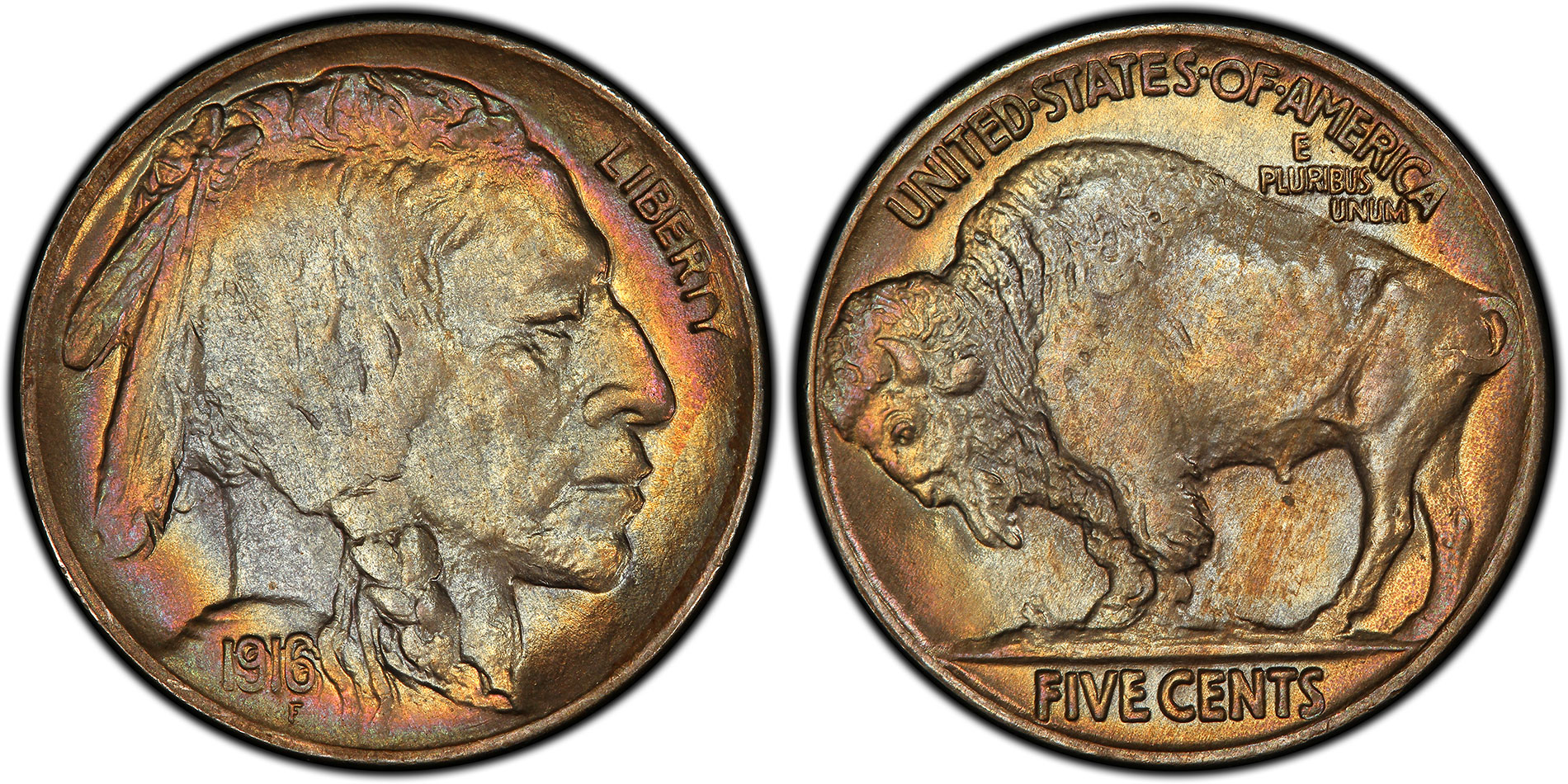
Regardless of status in terms of rarity or popularity, the 1916 Doubled Die is certainly a significant coin. Like so many of the rarest and most valuable doubled dies, this variety exhibits doubling that is clearly recognized by the naked eye. Almost any collector will be able to pick out a 1916 Doubled Die Buffalo Nickel from a lineup of regular 1916 Buffalo Nickels without the aid of a coin loupe or magnifying glass (and this should not be confused as an endorsement to forego buying a 5X or 10X loupe – doing so is the numismatic equivalent of walking a tightrope without a net!).
This doubled die shows unmistakable doubling of the date, chin, feathers, throat, and lips of the Native American chief depicted on the coin. The doubled segments are primarily seen southeast of their primary design hosts, with the most prominent areas of doubling evident in the “16” numerals of the “1916” date. While the authentic doubled die is easily apparent, collectors ought to be aware of the numerous 1916 Buffalo Nickels that exhibit other, less-valuable forms of doubling. A collector looking to purchase an example of this variety for their own collection is best served buying examples graded and encapsulated by PCGS, which has certified some 200 examples of this ultra-rarity.
The vast majority of examples are in circulated grades, with the plurality of those hovering between VG8 and XF40. Very few are known in uncirculated grades, and the highest grade coming in at PCGS MS64. Prices for this coin run the spectrum of the thousands, with even low-end specimens grading G4 fetching some $5,000. Pieces in the mid-circulated grades, say VF20, easily command $15,000. PCGS estimates just 10 examples are in the uncirculated grades, and it’s there that price records for this coin have been achieved. One example graded PCGS MS64 took $281,750 in a 2004 Bowers and Merena auction.
Sources
- Breen, Walter. Walter Breen’s Complete Encyclopedia on U.S. and Colonial Coins. Doubleday, 1987.
- Fivaz, Bill and J.T. Stanton. Cherrypickers’ Guide to Rare Die Varieties of United States Coins. Whitman Publishing, 2009.


 Copper & Nickel
 Silver Coins
 Gold Coins
 Commemoratives
 Others
 Bullion
 World
World
 Coin Market
 Auctions
 Coin Collecting
 PCGS News